
Scaling Beyond Open Source: Migrating from QuickFIX/J to Chronicle FIX
April 8th, 2026
QuickFIX/J is an accessible, free standard that serves as a great starting point for teams building their first FIX engine. But as your trading operations scale, the limitations of QuickFIX become apparent.
When throughput spikes and microsecond latency becomes a competitive necessity, firms outgrow QuickFIX. Clients typically migrate to Chronicle FIX to solve five critical challenges:
Throughput and latency bottlenecks during market data bursts.
Lack of native, robust HA/DR (High Availability & Disaster Recovery).
Missing advanced features like intelligent order routing and message translation.
Absence of global, enterprise-grade commercial support.
The need for an out-of-the-box GUI to empower operational teams.
Frictionless Migration Tooling
Because the upgrade path from QuickFIX/J to Chronicle FIX is so common, we engineered automated tooling to eliminate the heavy lifting.
Our migration tools automatically convert your legacy quickfix.ini configurations directly into Chronicle’s optimized YAML format. Furthermore, Chronicle FIX’s code generator consumes standard FIX XML dictionaries to automatically generate clean, performance-optimized Java POJOs and byte-backed flyweights for every message type, ensuring your system is optimized for speed from day one.
Deterministic Throughput & Microsecond Latency
Chronicle FIX was built from the ground up by low-latency experts to be the fastest Java-based FIX engine on the market. By leveraging unique, zero-allocation memory management techniques, Chronicle eliminates Garbage Collection (GC) pauses entirely.
Trusted by tier-one financial institutions across every major global trading hub, Chronicle FIX seamlessly scales to handle billions of FIX messages per week and manages thousands of concurrent FIX sessions without degrading performance.
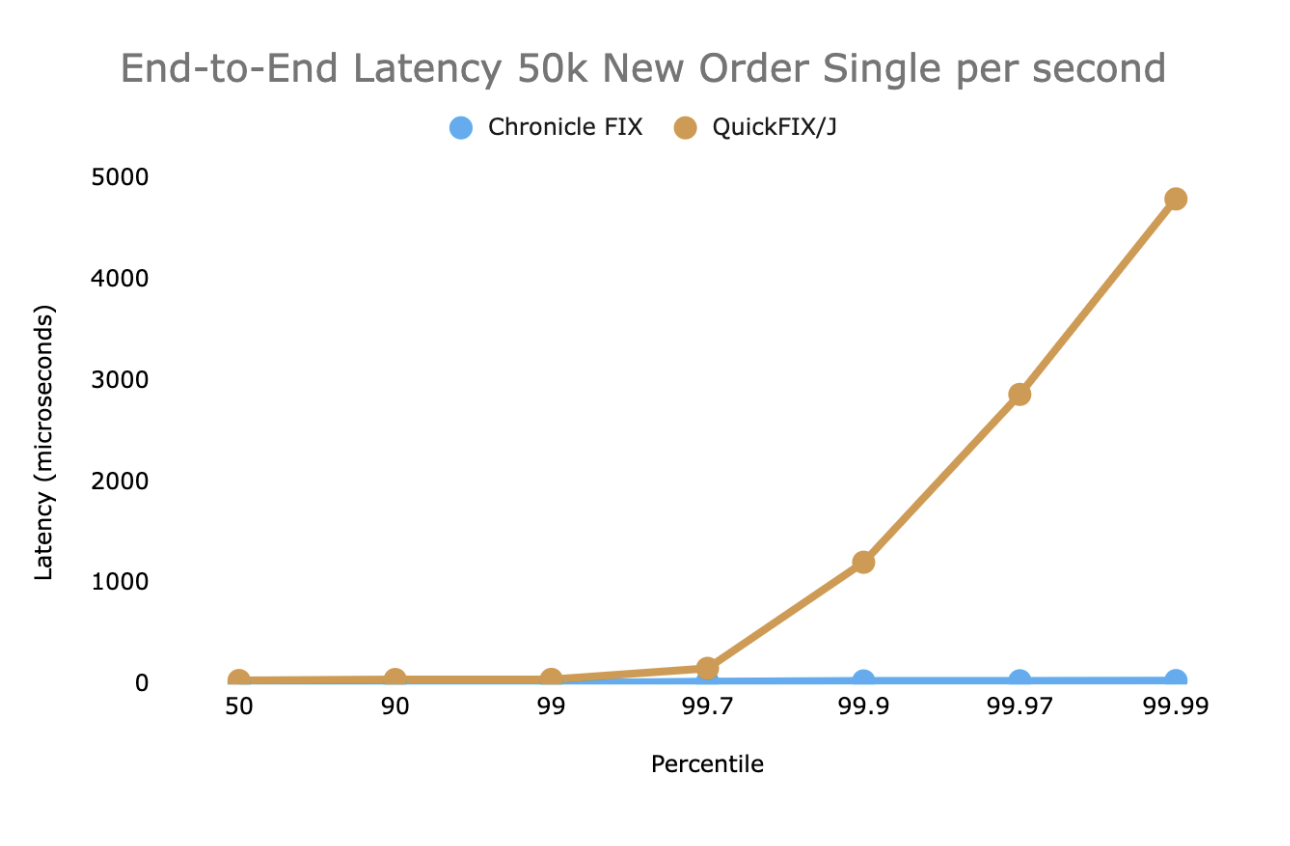
The Benchmark: Chronicle FIX vs. QuickFIX/J The performance difference is particularly stark at higher percentiles, where market volatility typically causes legacy engines to choke.
Benchmark Methodology: This test measures a full round-trip execution. It generates a NewOrderSingle (NOS) and sends it from one FIX engine to another over localhost. The receiving engine parses the NOS, generates an acknowledgment ExecutionReport, and sends it back. The sampled time is the total duration until the acknowledgment is parsed and delivered to the application.
Transparent HA/DR & Zero Data Loss
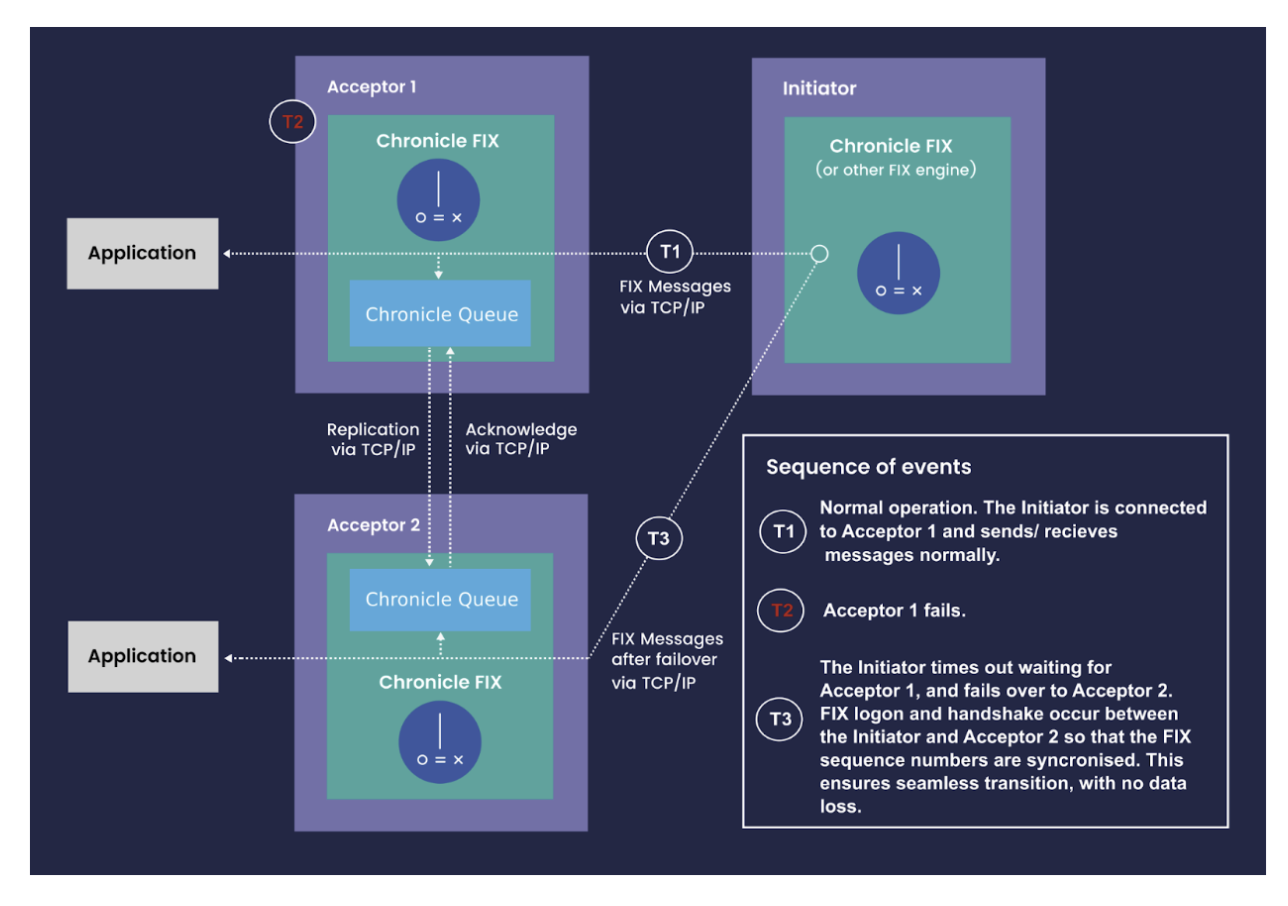
For mission-critical trading, downtime is not an option. Chronicle FIX provides transparent session failover for both initiators and acceptors.
Our architecture gives your business complete control over risk and latency trade-offs. The engine can be configured to hold message processing until data is fully replicated to another host, an adjacent rack, or an entirely different data center, depending on the message type.
The Result: Our customers routinely execute seamless failovers between FIX engines in milliseconds, with zero message loss, as part of their standard intraday deployment processes.
Empowering Operation Teams: The Chronicle FIX Management GUI
To relieve developers from routine maintenance and empower your operations team, Chronicle offers a comprehensive, out-of-the-box Management GUI add-on.
Eliminate the hassle of programmatic configuration or database diving. The intuitive web interface allows your teams to manage the entire FIX estate visually:
Session Management: Instantly reset sequence numbers and manage connections.
Configuration: Edit session parameters and schedule active session windows.
Message Search: Rapidly query, filter, and inspect historical FIX messages.
Intelligent Routing: Configure and deploy new routing rules on the fly.
Live Monitoring: Track real-time session health and connection status across the enterprise.