
Events and Data Transfer Objects in Chronicle Services
October 11th, 2023
Overview
In the previous article, we saw how to define, implement and run a simple application using Chronicle Services. We saw that a Service is a self-contained component that accepts input from one or more sources, and posts output to a single sink. Input and output are in the form of Events, and the overall architectural approach of Chronicle Services is based on Event-Driven Architecture, a style that promotes loose coupling, publish-subscribe patterns and real time event propagation between event producers and event consumers. By embracing a driven architecture EDA style, Chronicle Services enables stream processing and real time data exchange across microservices or larger monolithic deployments.
The example used in the earlier article was based on very simple data, accepting input as a pair of numbers and posting output as a single number. In reality, both input and output will consist of more structured data. In this article, we will explore the ideas behind Events in Chronicle Services in more detail, and how to build a service that works with Events carrying structured data. Along the way we will highlight how an event broker such as Chronicle Queue forms a high-throughput data streaming platform that delivers fault tolerance, low latency and deterministic performance.
The Example
We will discuss an example service that implements the application of a credit/debit transaction to an account. The service posts an event representing updated account information (including balance) once the transaction has been successfully applied. We will not consider error handling here, this will be covered in a later article. In practice, the arrival of a transaction is a simple event that may later be correlated with other updates to perform complex event processing to detect fraudulent patterns or overdraft limits.
The following diagram shows the service, and its input and output events:
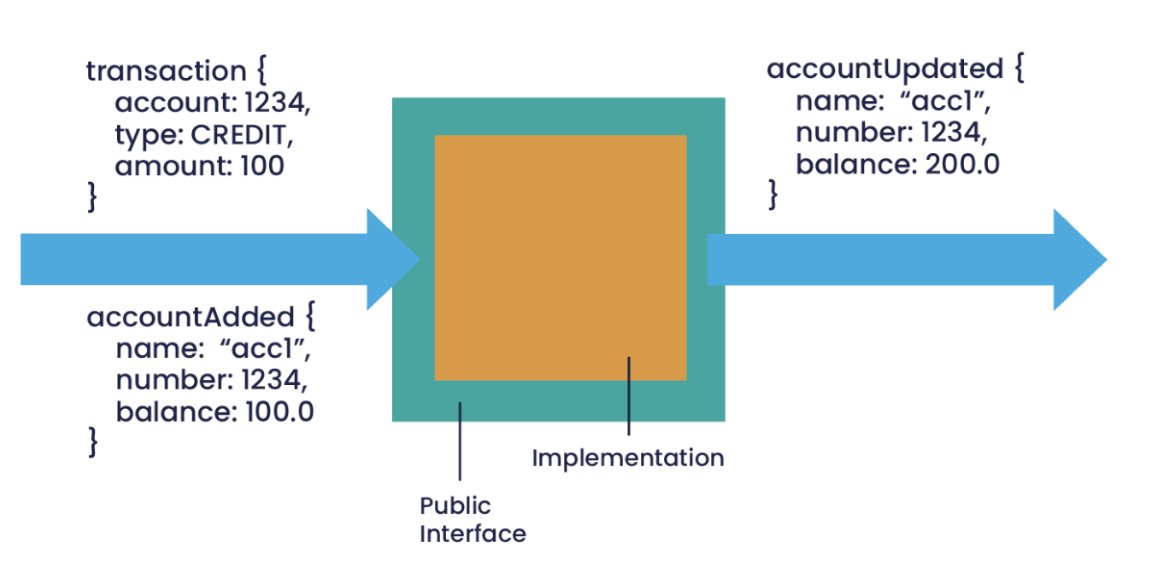
The service is required to maintain details of the accounts to which incoming transactions will be applied, details of how this state can be managed will be covered in later articles. For now, we are going to concentrate on Events being input and output. This clear separation of concerns exemplifies the benefits event driven systems gain from loose coupling and event channels for communication rather than tight request/response APIs.
What’s in an Event?
In Event-driven systems, an event is defined as an immutable indication that something has happened. Events should represent concepts relative to the domain of a service or application, and in high-volume environments they should also support real time processing so that downstream components can react without delay.
Chronicle Services represents Events in data structures with the structure shown below:
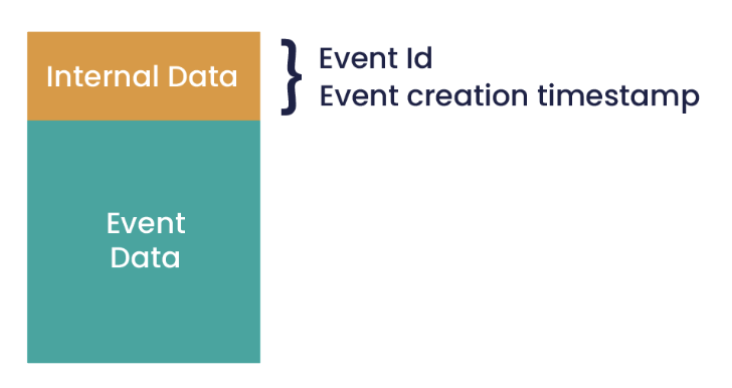
The Event id and Event creation timestamp fields are managed and used by the Chronicle Services runtime. In the business logic of a Service, we focus on the Event Data, which is defined as a Java class extending the base type AbstractEvent<E>
. The base class adds the Event metadata and provides the hooks that connect to the Chronicle Services runtime event handling, event source abstraction and serialisation functionality. An instance of this type is called a Data Transfer Object, or DTO. By treating every DTO as a lightweight carrier for domain data, we make it effortless to process events anywhere in the system without boilerplate.
As an example, consider the events labelled “transaction” in the diagram. The Event Data for this event is defined as follows:
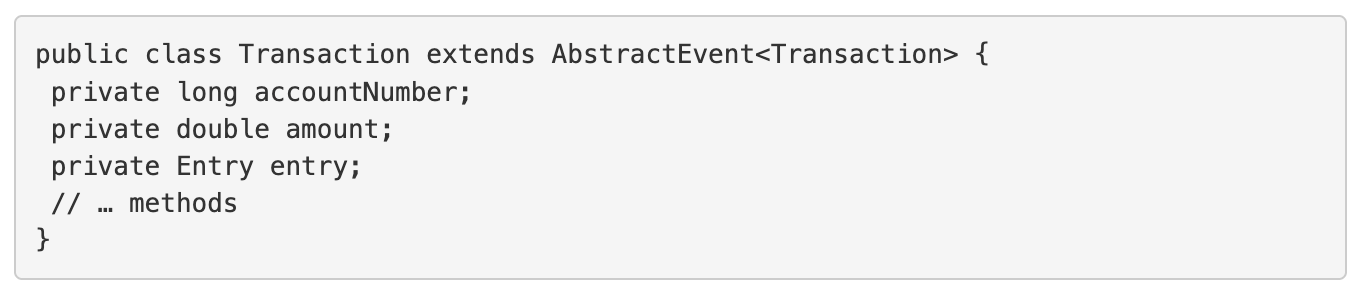
where the Entry type is defined separately:

No further definitions are necessary for the Event, all management and transmission capabilities are automatically made available through the AbstractEvent<Transaction>
base type. This constitutes a significant simplification over other transmission models that require generation of code for serialisation and deserialisation, or manual mapping often seen in traditional event driven programming approaches.
The Service API
The public interface of a Chronicle Service is defined by the Events that it is willing to receive, and those that it may post. These are defined in one or more Java interfaces. For example, the input Events for the example service can be defined in the following interface:

Each method represents a “type” of Event, with the parameter representing the DTO, which is the payload of the event. The clear alignment between Java method signatures and event channels reinforces a declarative event driven communication pattern where event producers simply invoke an interface and the infrastructure delivers the message to interested consumers.
The output events are defined in a separate interface:

Working with Events
One of the key aspects of performance in any system that interchanges data between components is the mechanism used to ensure the consistency of data being transmitted. Data represented as Java objects must be transformed into a format that is more suitable for sending over some Interprocess Communications medium, and back again at the receiving end.
Conventional approaches in microservice-based applications where HTTP is the most commonly used transport require this format to be text-based, and various encodings such as JSON, YAML or XML are used. However, the serialisation of Java objects to the transmission format for sending, and from the transmission format on receipt introduce significant overhead, in terms of both time and intermediate object creation, which places strain on the JVM’s memory management subsystem. These costs often negate the throughput promises of streaming platforms when many millions of processing events per second are required.
Chronicle Services uses Chronicle Queue as its default Event transport. Chronicle Queue and the associated Chronicle Wire library define an efficient binary format for the transmission of messages. Additionally, Chronicle Wire provides high-performance transformations of Java objects between their internal JVM representation and this “wire” format. As mentioned above, these transformations are automatically made available to Chronicle Services through the AbstractEvent<E>
type, which should be the base type of all DTOs used for Events. No intermediate code-generation phases or additional method implementations are required to achieve this. The actual serialisation and deserialisation of DTOs is performed without the need for intermediate objects, which significantly reduces memory pressure – indeed removing the need for regular minor garbage collections. This approach delivers sub-microsecond latency and supports real time processing requirements typically associated with algorithmic trading systems or mission-critical financial gateways.
Moreover, for diagnostic purposes, Chronicle Wire provides translation from the wire format into a text-based representation of the events, such as JSON or YAML. For example, a “transaction” Event can be seen as:
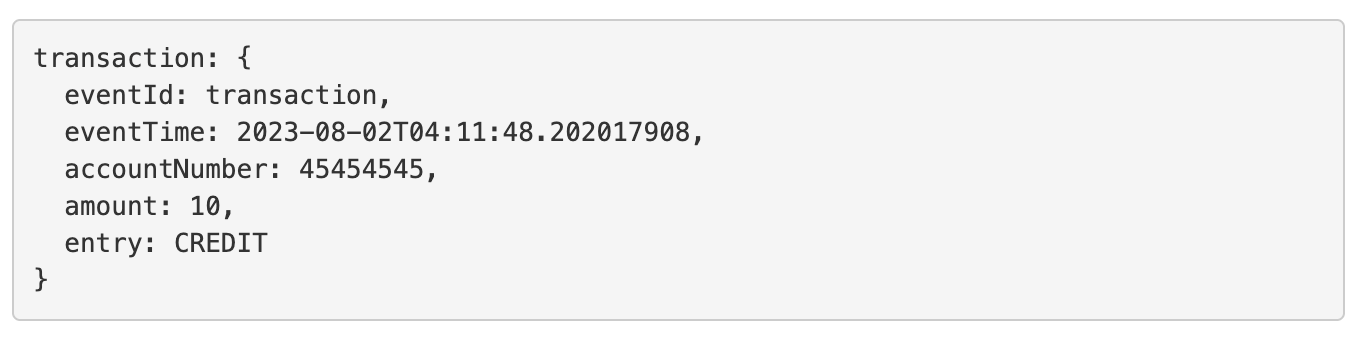
Notice the event id and timestamp that were added by Chronicle Services, and the remaining Event Data fields as defined in the Transaction DTO class. Human-readable formats are invaluable when tracing complex event flows, verifying out-of-order scenarios or correlating response events with their originating requests.
Sending and Receiving Events
Chronicle Services, through the highly tuned capabilities of the Chronicle Wire library, makes it straightforward to define how Events are sent and received.
The implementation class for a Service should implement the input Interface(s) that specify its incoming Events. The implementations of the methods in these interfaces become handlers for the incoming events, with Chronicle Services invoking them as soon as an Event of the correct “id” is detected on the input Queue. This design aligns with the reactive principles of event streaming where consumers are notified the moment a real time event arrives, facilitating immediate business logic execution.
So for the example above, the transaction() method is invoked with a parameter that is the decoded Transaction DTO.
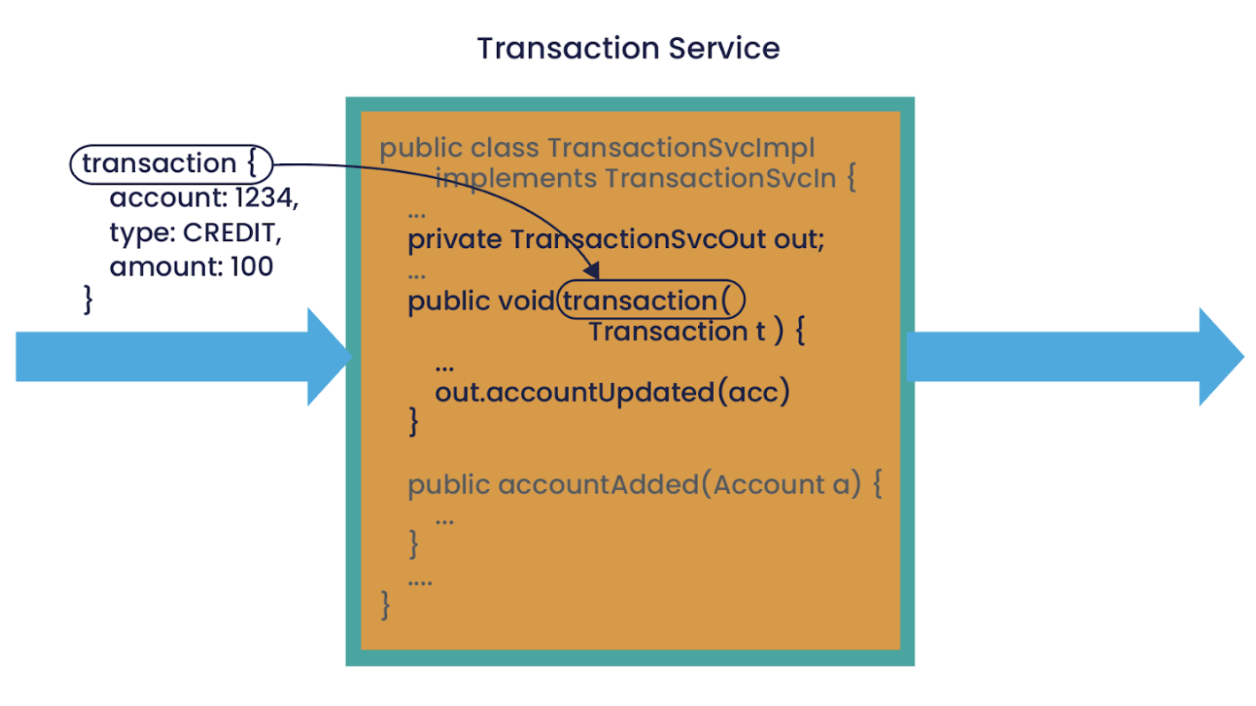
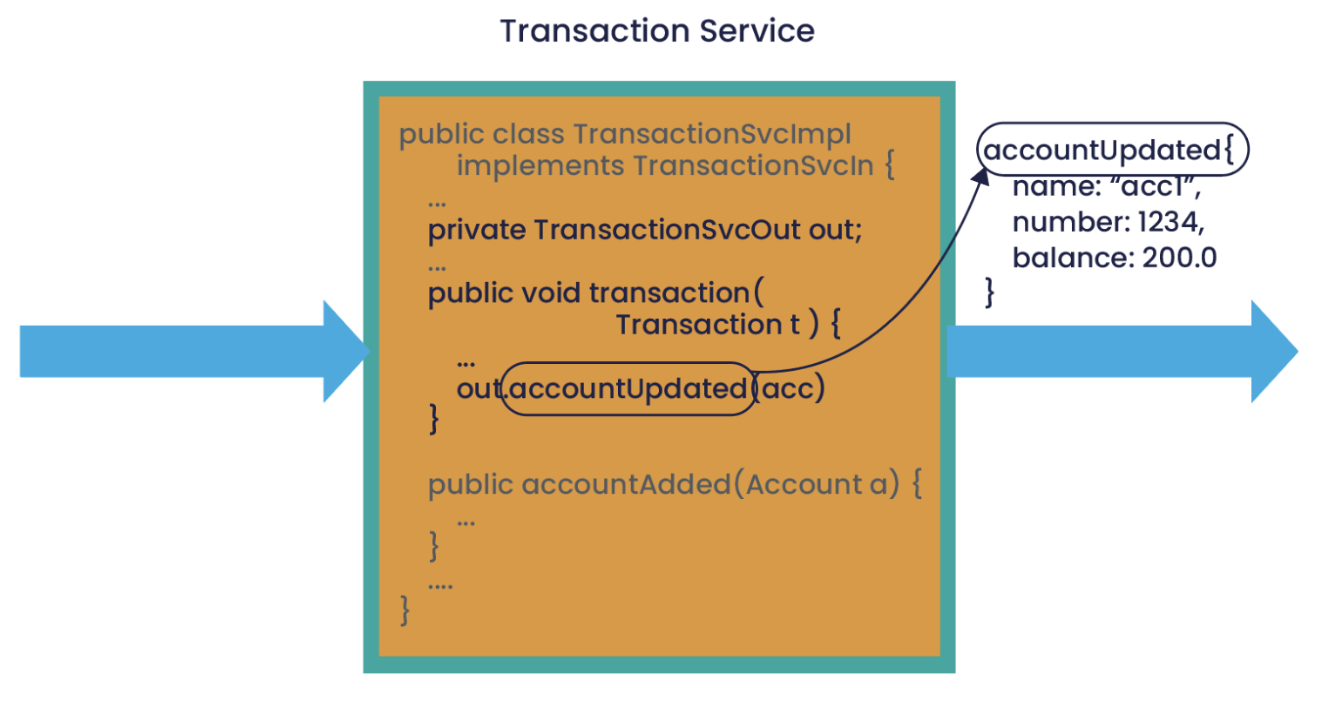
For outgoing events, an implementation of the output Interface is created by Chronicle Services and injected into the implementation class at construction time. When a method from the output Interface is invoked through this reference, Chronicle Services will serialise the associated DTO into the wire format and post it to the output Queue. The timestamp is set to the time at which the Event was serialised and posted. In effect, the service becomes an event producer for downstream components, which may perform simple event processing or aggregate multiple related messages for more sophisticated event stream processing tasks.
Summary
Chronicle Services is designed to support the building of applications that follow the guidelines of Event Driven Architecture. Loosely coupled components known as Services pass data using Chronicle Queue and related libraries, which have been proved to provide market leading latency figures. Whether you are integrating with Apache Kafka, deploying on a cloud-native streaming platform, or running an on-prem data streaming solution, Chronicle provides an event broker that excels at real time event propagation and ensures deterministic latency even under burst loads.
Services are developed with a focus on business logic. Connection to the underlying infrastructure is provided and managed by the Chronicle Services runtime and not through further API calls, which can introduce additional complexity and overhead into applications. This separation amplifies the benefits of event driven architectures: scalability, fault tolerance, simplified change management and the ability to process events independently in parallel without breaking existing contracts.