
Chronicle FIX: Much More Than a Quick Fix
July 15th, 2022
Many of our customers have upgraded from QuickFIX/J to Chronicle FIX and this article provides some background as to why. Chronicle Software’s FIX offering has become a cornerstone of core trading technology for trusted tier banks, trading firms and an ever-growing trading community that values ultra-low latency engineering.
Introduction
QuickFIX/J is free, accessible, supports the FIX standard and is therefore often chosen by the IT team for a first FIX engine. However, when the business grows, its limitations become clear, especially when ambitious trading systems must handle massive throughput, satisfy regulations including MiFID and deliver consistent latency under peak load. The reasons most commonly given to us are:
Throughput and latency
HA/DR functionality
Advanced features e.g. routing and message translation
Global commercial support
Also, some customers engage with us because they already use our enterprise products, e.g. Chronicle Queue Enterprise replication, Chronicle Services EDA/Microservices accelerator and other products Chronicle offers that build on the same deterministic framework Chronicle created for performance at scale. Many of these financial institutions are deployed largest banks running azul zing zulu JVMs and the fastest Java stacks in production.
See below sections for more detail, including an overview trading community perspective and answers to a list common questions we regularly receive.
Upgrading
Chronicle provides tools to assist in the upgrade from QuickFIX/J, e.g. to automatically convert configuration from quickfix.ini to Chronicle YAML format, and upgrades to Chronicle FIX are typically very smooth – with one customer we helped them convert one of their applications in an afternoon. Chronicle FIX’s code generator uses standard FIX XML files and generates clean, performance-optimised POJOs and byte-backed flyweights for each message type, enabling messages custom parser logic to be plugged in where bespoke business logic is required.
Because the Chronicle engine shares the same data model and event semantics across our broader stack, developers can re-use knowledge gained from Chronicle Queue and Chronicle Services without friction. Choosing Chronicle engine components therefore reduces project risk while accelerating time-to-market.
FIX Features
Below see more details on Chronicle FIX features and attributes. These have been proven in production environments with deployed sessions globally across multiple asset classes.
Throughput and latency
Chronicle FIX has been built from the ground up by low-latency experts to be as fast as possible and leverages many ingenious techniques and patterns, some of which we believe are unique in the industry. The Chronicle latency engine achieves microsecond round-trip performance, ensuring the latency engine delivers consistent latency even during burst traffic.
Chronicle FIX is trusted by some of the world’s largest financial institutions, is deployed in all the major financial centres, and has proven to be efficient and scalable – handling billions of FIX messages per week for some customers, and scaling out to thousands of FIX sessions at others. As a result, Chronicle handles billions of market events daily while preserving determinism.
The below diagram speaks for itself and shows Chronicle FIX multiple times faster than QuickFIX/J, with the ratio particularly noticeable at higher percentiles.
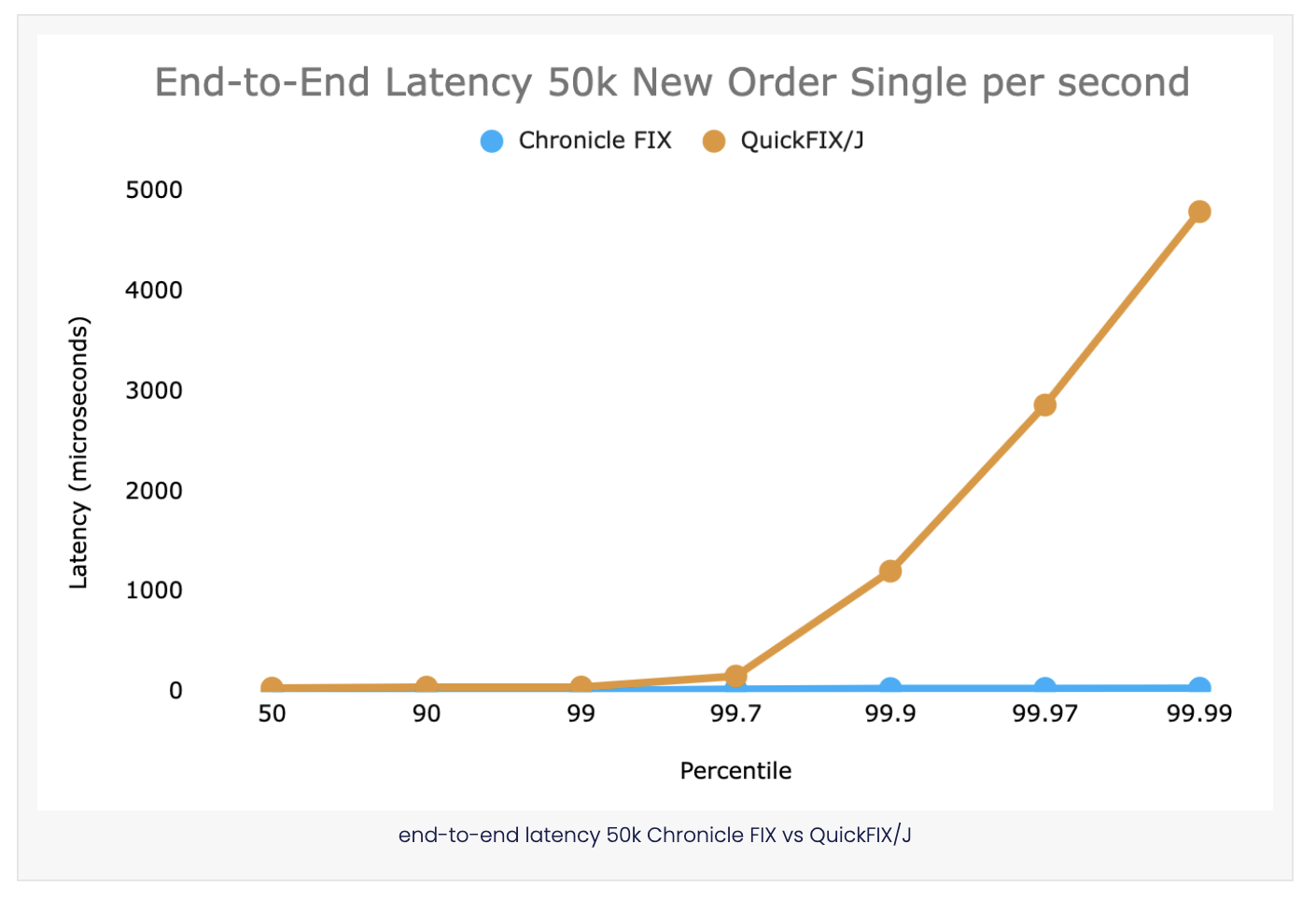
Note: the benchmark exercises a full round trip, i.e. it generates a NewOrderSingle (NOS) and sends it out from one FIX engine to another engine over localhost. The second engine parses the NOS, generates an ack ExecutionReport, and sends this back to the first engine. Once this has been parsed and delivered to the application, the time taken is sampled. Tests were executed on a Java engine running Azul Zulu, showcasing how the fastest Java techniques translate into real-world advantage.
HA/DR
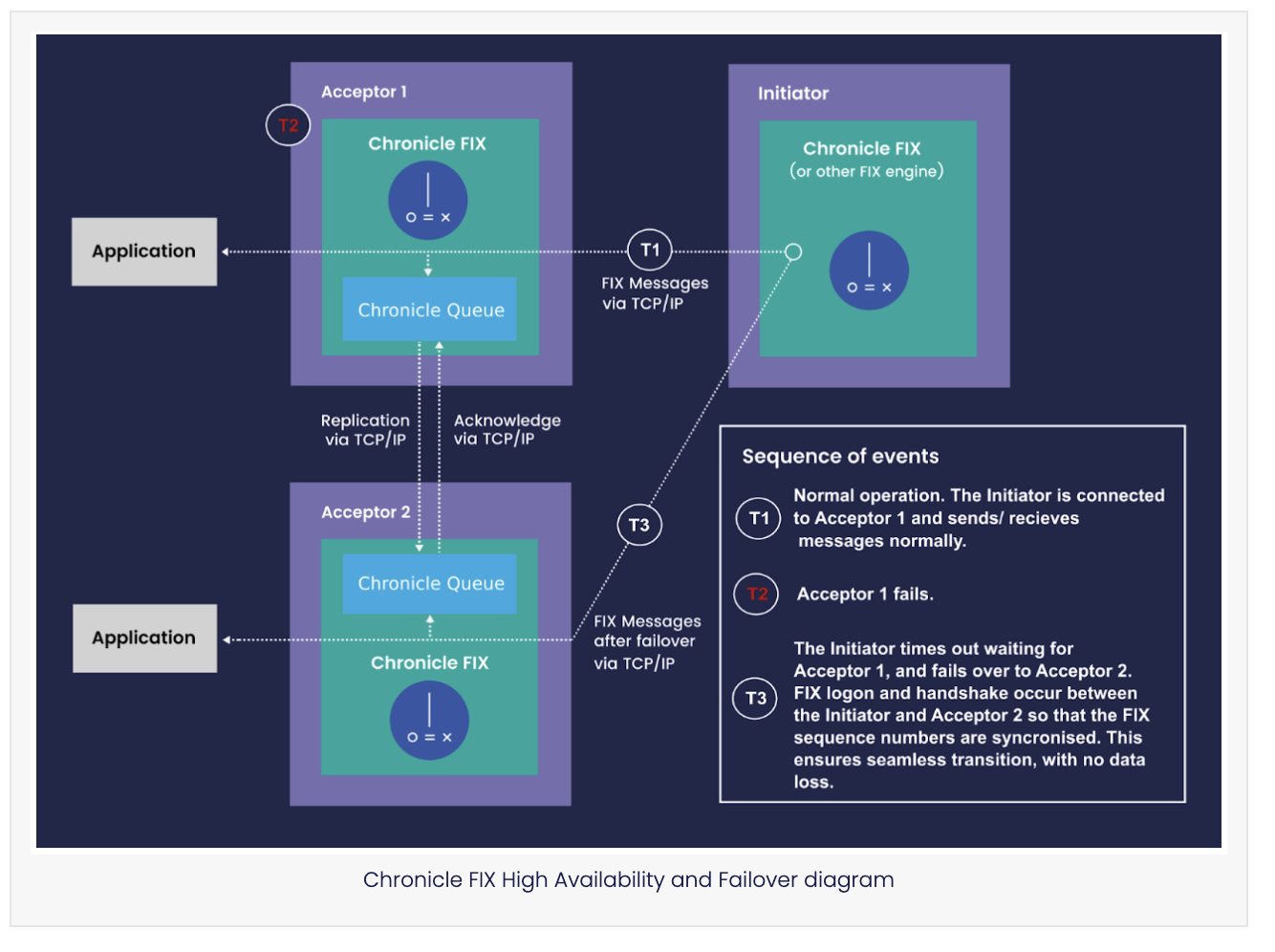
Chronicle FIX has support for transparent session failover for initiators and acceptors, with flexible configuration to allow the business to determine the level of risk – the engine, for example, can be configured to only process messages that have been replicated to another host, another rack, or another data centre, depending on message type. In short, HA DR design is baked into the DNA of the framework Chronicle delivers.
We have customers who – as part of their standard deployment process – failover between FIX engines in milliseconds with no message loss, even while operating under aggressive SLAs demanded by trusted tier banks.
Additionally, there is a lightweight proxy component which supports common patterns such as load balancer distribution, transparent SSL, and rule based routing.
Most customers deploy on-prem or colo, but the cloud is also supported, enabling hybrid strategies.
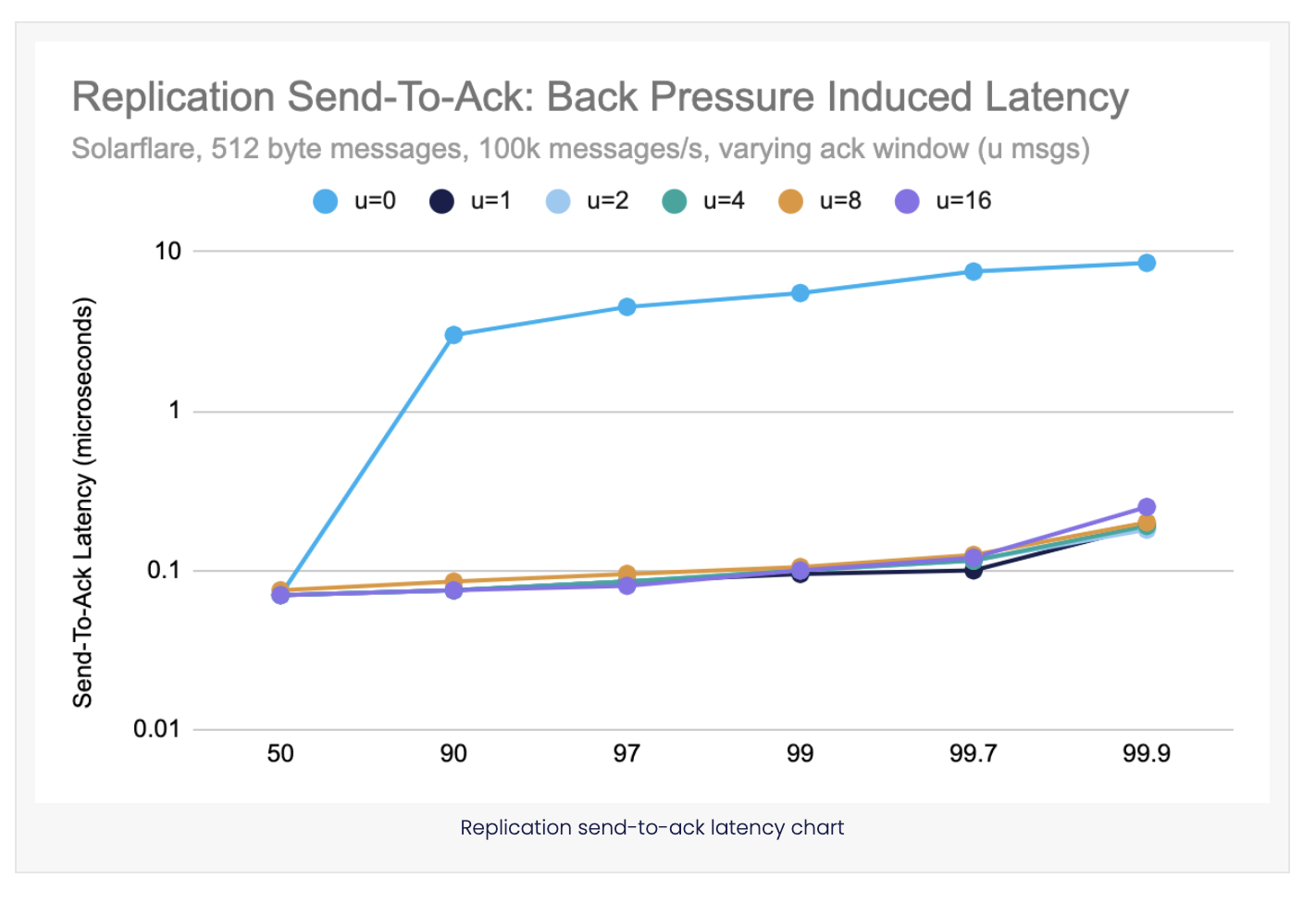
Chronicle FIX leverages Chronicle Queue Enterprise replication to achieve HA/DR, and the below graph shows the latencies that can be expected using CQE. The below graph shows the send/ack round-trip/latency impact on the sender as the number of outstanding messages (u) varies. u=0 is fully synchronous replication, ideal for events Chronicle Queue must guarantee.
Features
Chronicle FIX implements additional features which have been driven by customer requirements, e.g.:
Supports all FIX versions, ITCH, and SBE (Refinitiv, iLink, etc.) protocols. Support for Refinitiv iLink protocols and itch sbe refinitiv variants means one engine support layer can cover both exchange and dealer connectivity.
Rules-based routing with seamless translation between schemas
Load balancing to help distribute load across multiple internal servers transparently to clients
Allows a site to present a constant connection surface to clients, hiding the internal layout of machines
De-risk internal server updates (e.g. by routing only a subset of flow onto new/updated servers)
Provides a rule-based Drop-Copy service
FIX version translator/adaptor that supports versions up to the latest, plus SBE Refinitiv iLink requirements
Because these functions are handled inside the Chronicle latency engine, they introduce minimal overhead and preserve fastest Java performance.
Manageability & Monitoring
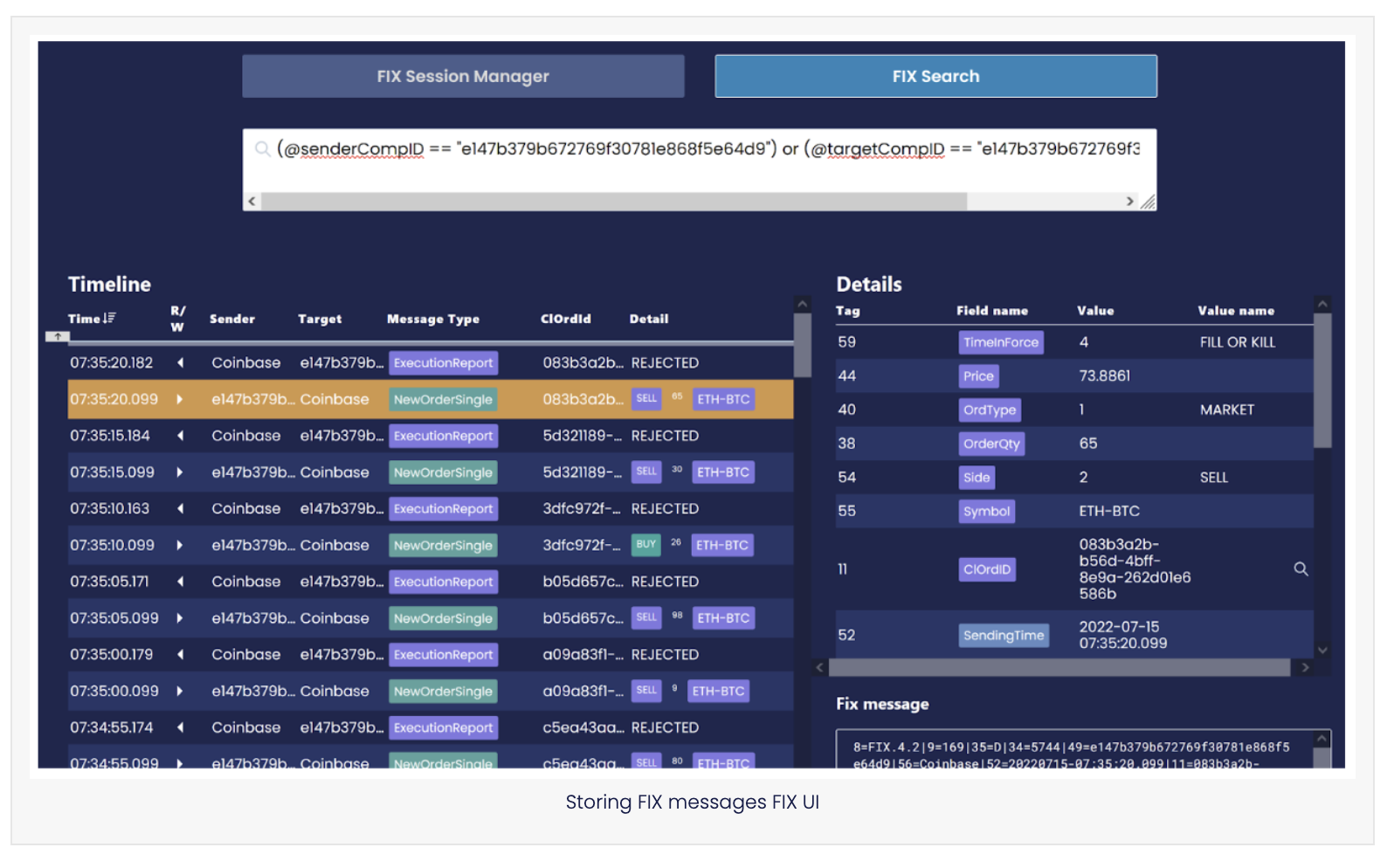
The engine can be controlled from customers’ tooling via API, or with the GUI. Operational staff therefore interact with the same framework Chronicle provides across our wider suite, simplifying run-books.
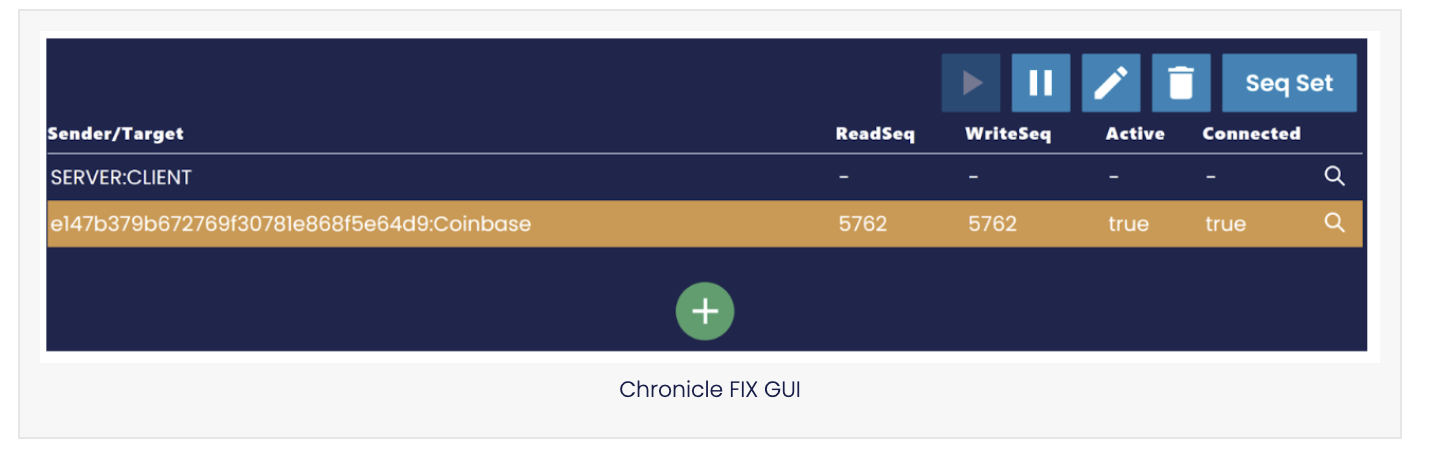
And all FIX messages are stored, indexed and are searchable with a sophisticated query language, allowing historic events Chronicle teams may need for compliance or audit to be retrieved within milliseconds.
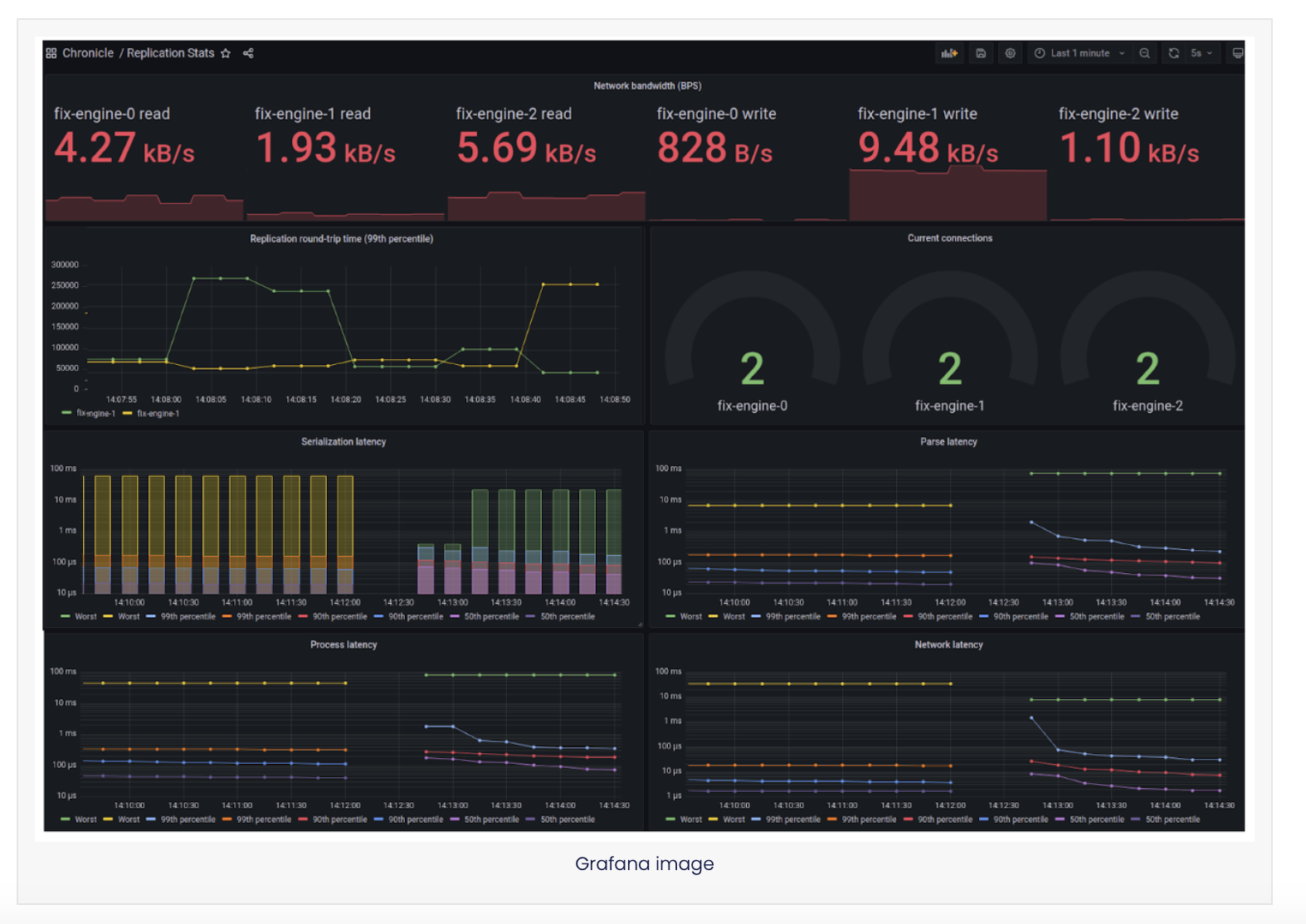
All important metrics, including latency numbers, are exposed via the monitoring features and can be surfaced in your monitoring tool of choice, e.g. Grafana. Pre-built dashboards give operations an instant overview of trading chronicle health.
Commercial Support
Chronicle offers commercial support from our team of experts, who are located in all major Time Zones. Engine support packages cover implementation guidance, upgrades, performance tuning and proactive knowledge transfer so clients can maintain independence.
Whether you are a boutique fund or an organisation deployed largest banks across continents, the same engineering excellence is available on demand.
Conclusion
When building your production FIX stack you likely want something more than a quick fix. Chronicle FIX provides best-in-class performance, full HA/DR, advanced features and global commercial support. It is part of a coherent framework Chronicle Software continues to innovate on, ensuring your business logic remains future-proof while latency targets remain uncompromised.