
6 Considerations when Building High-Performance Java Microservices with EDA
July 31st, 2023
Building microservices in Java has never been more popular, with development teams frequently turning to proven stacks such as spring boot, spring webflux, spring data jpa, spring data jdbc, and even boot spring–based tooling to accelerate delivery. Yet when the goal is truly high performance Java microservices that can thrive in cloud native, distributed systems, simply choosing a framework is only the starting point. You must embed performance microservices principles and an event driven mindset into every layer of your architecture.
Below, we outline key considerations and tactical guidelines that will help you achieve low-latency, resilient, and scalable microservices. By weaving together the benefits microservices offer—independent deployability, optimised developer productivity, and effortless horizontal scaling—with an event driven architecture, you can create Java based microservices capable of sustaining microsecond latency even under extreme load.
Event-Driven Architecture (EDA) is a design principle focused on the creation, detection, and reaction to events. Renowned for its resilience and low latency, EDA is a reliable choice for developing robust, high-performing microservices. Moreover, this method can be helpful in improving productivity, reducing the memory footprint of your services, and making the process of cloud migration smoother—all of which contribute to better building performance.
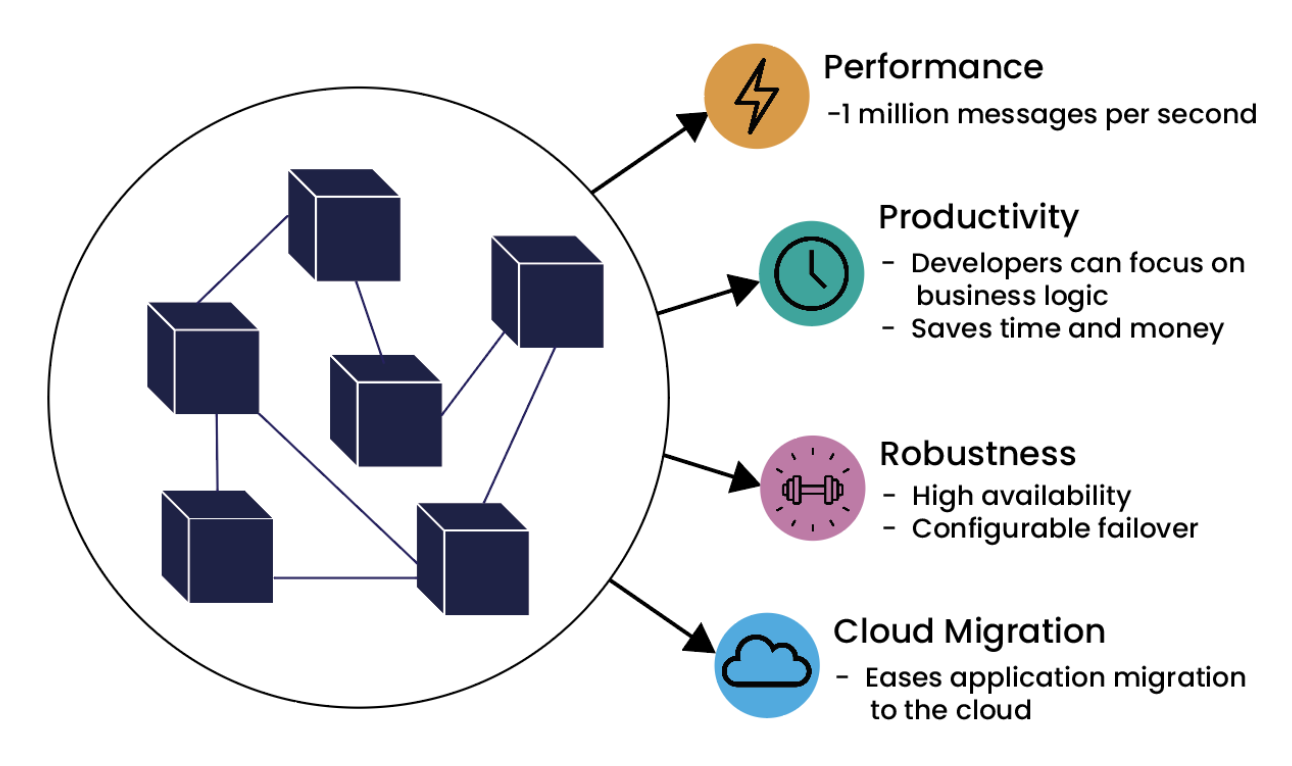
In this article we will outline 6 key considerations and tactics for developing such services. These insights complement familiar best practices from the spring ecosystem and the wider java microservices community while adding unique Chronicle Software perspectives on deterministic, ultra-low-latency event processing.
1. Crafting Event-Based Microservices
Within EDA, microservices interact with each other through events. An event is simply an immutable indication that something has happened. Microservices register their interest in a subset of events and perform their processing by reacting to these events when they occur. On completion of handling of an event, microservices will usually post one or more events reflecting the result of this processing, which will trigger further downstream microservices, enabling natural support for event driven architecture patterns such as CQRS and microservices EDA.
For simplicity, we treat all inputs as recorded, replayable events. These inputs include the wall clock, reference information, configuration details, commands, and queries. For instance, timestamps are derived from the most recent wall clock event, so they are replayable, and a command or query is modelled as an event signifying that such a command or query has been requested. Teams familiar with jpa hibernate or data jpa repositories will notice that the same principles of immutability and event sourcing can dramatically reduce performance latency by avoiding expensive distributed transactions.
The EDA environment manages events using an immutable, ever-growing journal or log. This methodology means that microservices become less reliant on each others’ internal operation (loosely coupled), making systems more flexible in many ways, facilitating different deployment options, and improving scalability across large distributed systems.
Microservices developed within an event-driven framework are inherently simpler to design, test, and reason about. Each microservice is a function of its code and all the events it has ever processed. This aspect simplifies the creation of behaviour-driven tests, essentially boiling down to a data-in and data-out scenario. This not only accelerates developer productivity but also simplifies the maintenance of the software, which is a core objective when building microservices java teams can operate confidently in production.
2. Implementing Application Logic within an Event-Driven Context
In an EDA application, events are defined to model those in your business domain. Application components react to these events in ways that model the activities of your business processes. Data associated with an event encapsulated within the event’s payload can be implemented in the application as a Data Transfer Object (DTO). Representing events in a single, immutable event stream has the additional advantage of providing an audit trail of all the state changes that have occurred during the execution of the application, making it easier to analyse unexpected behaviour, generate test environments that mirror production environments, and satisfy regulatory requirements. The event stream becomes the single source of truth throughout the application.
Many organisations adopting java spring boot or spring data technologies find that layering an event driven approach on top of traditional REST endpoints unlocks new levels of observability and performance microservices java teams require. By coupling these patterns with native image compilation (for example, leveraging GraalVM) you can shrink start-up times and improve the overall memory footprint, which is critical when you deploy tens or hundreds of boot microservices across a Kubernetes cluster.
Adopting a lightweight, comprehensive recording strategy eliminates the need for extensive logging, minimising overhead and latency. To replicate the application’s state, retrieve the event journal and replay the microservices to the desired point. This approach allows you to debug and verify issue resolutions in the application proactively rather than waiting for the issues to recur, simultaneously reinforcing the reliability goals that any organisation pursuing building performance must uphold.
3. Optimising Microservice Performance
Using high performance, low latency messaging, microservices can communicate as fast as threads in a monolith while still maintaining key benefits of microservices. These include distinct contracts between components, independent testing and development, a comprehensive record of all interactions, and independence in deployment strategies. When combined with non-blocking stacks such as spring webflux or lightweight java-based frameworks like Chronicle Services, you gain the dual edge of reactive programming and deterministic throughput—both essential for performance microservices operating at scale.
Despite a system being distributed across numerous data centres globally, the efficiency of these microservices means that a single machine can effectively handle the critical, most latency-sensitive processing tasks. This is a hallmark of cloud native, event driven solutions that prioritise performance latency without sacrificing reliability.
We generally conduct latency benchmarks for single-threaded services at one hundred thousand events per second. A service requiring higher throughput can handle loads exceeding a million events per second, an achievement that underscores how deliberate building performance java techniques and efficient data pipelines let you outpace traditional monoliths or heavyweight application servers.
Moreover, each component will operate fastest when event processing is performed in a single thread since this eliminates the significant overhead of lock contention, as there will be no concurrent access to mutable state within the component. This mirrors the actor-style concurrency models popularised in modern microservices architecture and complements optimisation strategies such as compiling to a native image for smoother scaling and reduced GC pauses.
4 – 6. Event Replication, Deterministic Services, and Live Upgrades
We use Chronicle Queue as an event store, with total ordering and replication of this journal. From leader to followers, followers will see exactly the same data in the same order, with the same identifier for each message. Such deterministic replication is crucial when you require bullet-proof consistency across globally distributed systems, especially in financial services where every microsecond and every byte of data counts.
Chronicle Services is a Java-based Microservices framework that provides features which can be used to ensure that your services are deterministic. You can be sure that the follower services will be in the same state as the leader and be ready to take over from it. This deterministic behaviour aligns with the goals of microservices eda, where event streams, not mutable databases, define system state, and where performance microservices workloads must survive failures without degrading throughput.
We see increasing demand for support for live upgrades, and our consulting team can help you build services that can seamlessly transition between instances running different software versions and revert back if necessary. By leveraging strategies similar to those employed in rolling updates for spring boot microservices or in java microservices eda blue-green deployments, you minimise downtime and maintain service-level objectives during rapid iteration cycles.
Support and Assistance
At Chronicle Software, our Chronicle Services Framework and our Chronicle Queue messaging layer will empower you to create your high-performance, resilient microservices architecture. Whether you are enhancing an existing java spring boot estate, integrating spring data, or migrating to a fully event driven architecture, our tooling helps you capture, replicate, and process data with confidence. You can leverage our software to build your solution, and we can offer support and workshops to guide you through this process, ensuring that your building microservices java initiative achieves world-class latency and throughput.
Additionally, you can augment your team by working with someone from Chronicle Software. We suggest investing in ongoing production support to ensure smooth operation, optimise memory footprint, and maintain system reliability once your system is in production. Our experts frequently assist clients in fine-tuning performance microservices java workloads, profiling JVM behaviour, and advising on best practices for event processing, JPA hibernate integration, and cloud native deployment.